

Useful tools
Tools and trackers for your eosinophilic esophagitis (EoE) journey
Living with EoE can be quite difficult.1,2 Take advantage of the resources on this page to learn useful information and terms about the condition and how to get the support you need for you or your loved one.
Whether it’s help with finding a specialist doctor, learning more about EoE, or tracking your symptoms, these downloadable resources have you covered.
Resources for Your Treatment Journey

Your helpful guide to EoE
Read our helpful guide to know the signs and symptoms of EoE.
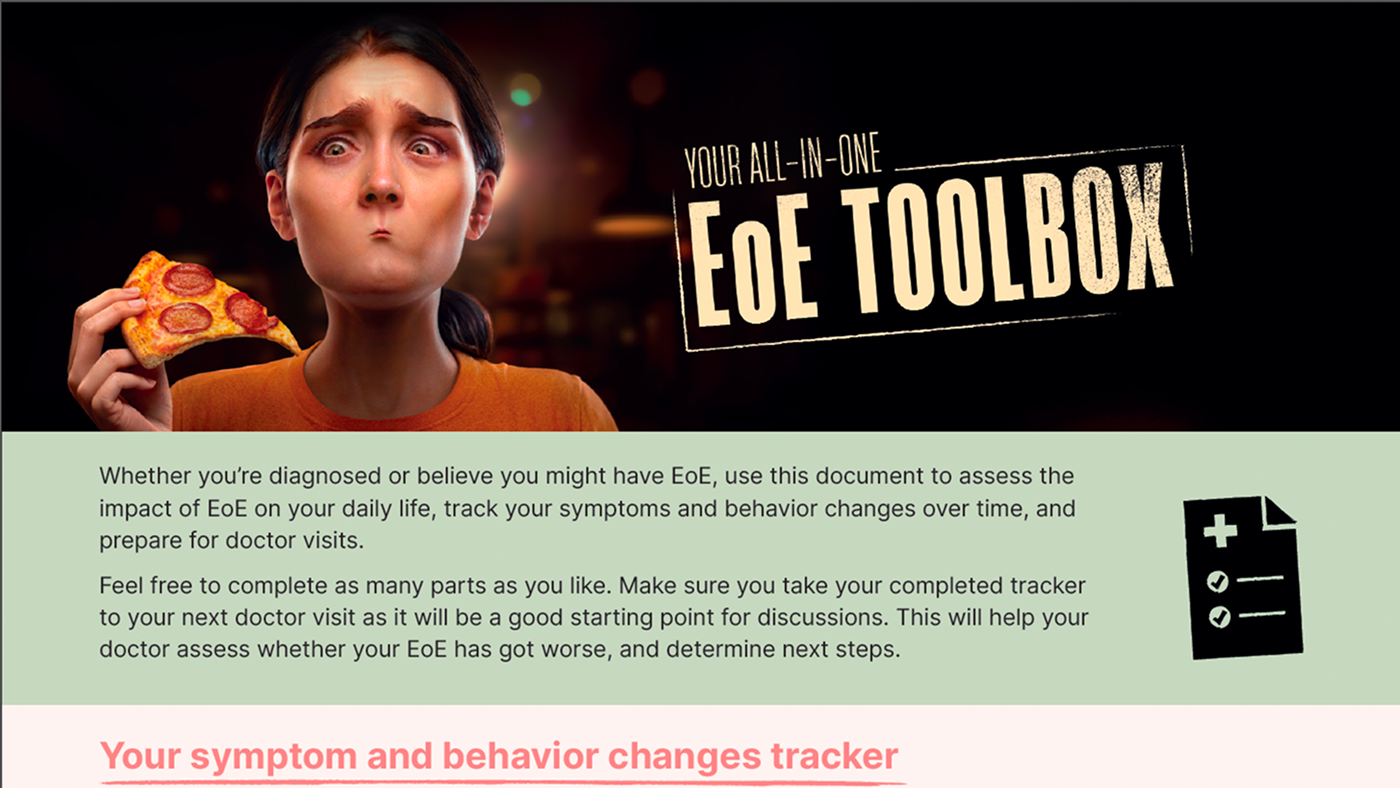
EoE toolbox
If you're diagnosed or believe you might have EoE, this all-in-one tracker will help you monitor your symptoms, prepare for doctor visits, and assess the impact of EoE on your daily life. Show this to your doctor to ensure you receive the best treatment and care.

EoE community
View a collection of first-hand accounts from people living with EoE at your fingertips, offering insight, support, and inspiration to support you on your EoE journey. You’ll also find useful information on patient associations and community events.
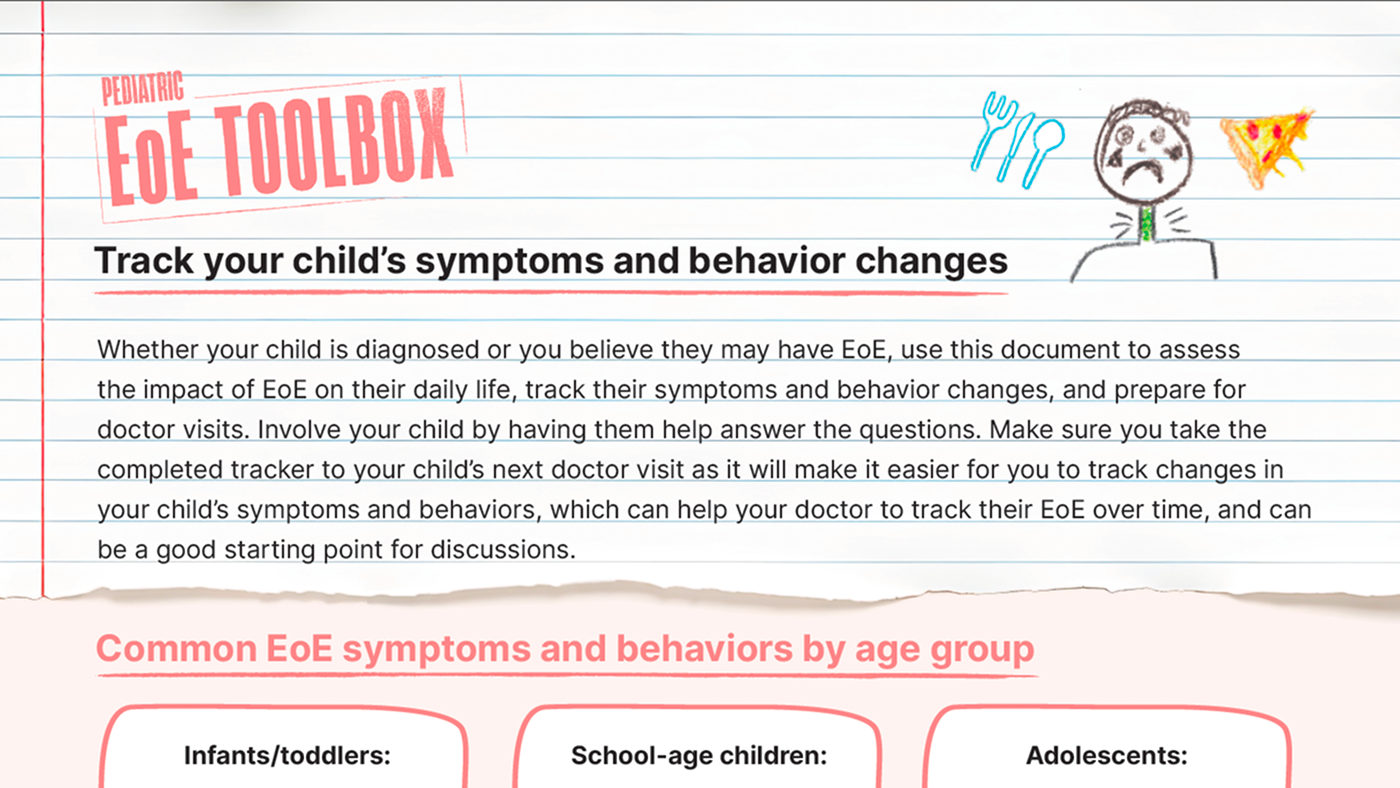
EoE pediatric toolbox
If you're diagnosed or believe you might have EoE, this all-in-one tracker will help you monitor your symptoms, prepare for doctor visits, and assess the impact of EoE on your daily life. Show this to your doctor to ensure you receive the best treatment and care.
Find your support community
You don’t have to navigate EoE by yourself. Connecting with others can provide comfort and guidance, build understanding, and raise awareness about the condition. Consider these actions:

Join a local EoE support group

Share with others your experience of living with EoE

Learn about efforts to expand EoE research

Hear from our voices of EoE
Glossary
Below is a list of terms commonly used when talking about EoE and its management, defined to help you on your EoE journey.
A
Allergen: A substance that your immune system mistakenly identifies as a threat, causing an inflammatory reaction in some people. Common allergens include pollen and certain foods.3
Allergist: A doctor who specializes in treating allergies, asthma, and other immune conditions.4
B
Biologics: Biologics are medications designed to target one of the sources of inflammation in your immune system. If you have EoE, a biologic treatment may reduce inflammation in your esophagus and help to relieve your symptoms.5
Biopsy: The process of taking a sample of tissue from the body to examine it more closely. A biopsy of the esophagus is needed to properly diagnose EoE.4,6
D
Diet modifications: Diet modifications involve changing what you eat or the way you eat to help manage conditions like EoE. These can include elimination and/or elemental diets (defined below). However, it is important to discuss any modification with your doctor first, to make sure you are getting proper nutrition.5
Dysphagia: Difficulty swallowing foods or liquids, arising from the throat or esophagus – one of the most common EoE symptoms.7,8
E
Elemental diet: A diet that provides all essential nutrients in liquid form, making food easy to digest. It may be implemented to help improve your EoE symptoms.5
Elimination diet: A management option used if you have EoE that excludes common ‘trigger’ foods from your diet to see if it helps improve symptoms. These foods often include wheat, milk, egg, nuts, soy, fish, and shellfish.5
Endoscopy: A procedure used to visually examine your throat and esophagus. It is done with the help of a tiny camera on the end of a long, flexible tube. A doctor (gastroenterologist) performs an endoscopy to diagnose conditions and prescribe the appropriate treatment.5,4 Endscopy may also be used to assess whether your EoE is getting worse.9
ENT specialist: A doctor (otolaryngologist) who specializes in diagnosing and treating conditions relating to the ears, nose and throat, as well as the head and neck.10
Eosinophils: Normal type of white blood cells that are produced in your bones and migrate to the rest of the body. Eosinophils work with other white blood cells to fight foreign substances that invade the body.11
Eosinophilic esophagitis (EoE): A long-term (chronic) immune condition where the lining of your esophagus – the tube that connects your mouth to your stomach – is inflamed.5
Esophageal dilation: A surgical procedure where your doctor dilates, or stretches, a narrowed area of your esophagus.12
G
Gastroenterologist: A doctor (specialist) who specializes in the health of the digestive system – including the esophagus, stomach, and intestines.13
Gastro-esophageal reflux disease (GERD): GERD is caused by stomach acid flowing back into the esophagus, known as acid reflux, leading to heartburn, irritation, and difficulty swallowing. Although symptoms may overlap in EoE and GERD, they’re treated differently.14-17
I
Immune system: The defense system that protects your body against harmful substances and invaders, such as bacteria and viruses. The immune system is made up of many different cell types and organs.18
Inflammation: Your body's response to damage caused by bacteria, harmful substances, injury, or other factors.19
O
Otolarynologist: Otherwise known as an ENT doctor. A specialist in diagnosing and treating conditions relating to the ears, nose and throat, as well as the head and neck.10
P
Pediatrician: A doctor who treats illnesses, injuries, and other health conditions specifically in infants, children, and adolescents.20
Primary care physician: A doctor who helps manage your overall health. They are typically your main point of contact for basic medical care.21
Proton pump inhibitors (PPIs): PPIs are medications typically used to treat a range of gastrointestinal disorders. They reduce the amount of acid the stomach makes, which may help reduce inflammation. They are also commonly used in EoE to help alleviate symptoms.22
S
Swallowed topical steroids: Topical steroids (corticosteroids) are a type of drug that reduce inflammation. For treating EoE symptoms, they can be taken as a slurry – a liquid with a thickener, such as a sweetener, to help it taste better – or as a powder that requires an inhaler.23,24
T
Type 2 inflammation: Your body's response to a trigger, such as an allergy, that causes your EoE symptoms. Type 2 inflammation stays even when the trigger that caused it goes away and can result in increased inflammation in the esophagus.25,26
References
- Pokrzynwinski R et al. Adv Ther. 2020; 37: 4458–4478.
- Gonsalves NP. Dig Dis 2014; 32(1–2): 89–92.
- Mayo Clinic. Food Allergy. Available at: https://www.mayoclinic.org/diseases-conditions/food-allergy/symptoms-causes/syc-20355095 Accessed November 2024.
- John Hopkins Medicine. Eosinophilic Esophagitis. Available at: https://www.hopkinsmedicine.org/health/conditions-and-diseases/eosinophilic-esophagitis Accessed November 2024.
- American Academy of Allergy Asthma & Immunology. Eosinophilic Esophagitis. Available at: https://www.aaaai.org/conditions-treatments/related-conditions/eosinophilic-esophagitis Accessed October 2024.
- Cleveland Clinic. Biopsy. Available at: https://my.clevelandclinic.org/health/diagnostics/15458-biopsy-overview Accessed November 2024.
- Deepika K et al. Cureus 2020; 12(4): e7898.
- NIDCD. Dysphagia. Available at: https://www.nidcd.nih.gov/health/dysphagia Accessed November 2024.
- Dellon ES, et al. Am J Gastroenterol 2025; 120: 31-59
- Cleveland Clinic. Otolarngyologist. Available at: https://my.clevelandclinic.org/health/articles/24635-otolaryngologist. Accessed July 2025
- Cleveland Clinic. White Blood Cells. Available at: https://my.clevelandclinic.org/health/body/21871-white-blood-cells Accessed November 2024.
- Cleveland Clinic. Esophageal Dilation. Available at: https://my.clevelandclinic.org/health/procedures/esophageal-dilation Accessed November 2024.
- American College of Gastroenterology. What is a Gastroenterologist? Available at: https://gi.org/patients/gi-health-and-disease/what-is-a-gastroenterologist/ Accessed October 2024.
- Wong S et al. World J Gastrointest Pathophysiol 2018; 9(3): 63–72.
- Lenti MV et al. Dig Liver Dis 2021; 53(12): 1632–1639.
- Katz PO et al. Am J Gastroenterol 2022; 117: 27–56.
- Hirano I et al. Gastroenterology 2020; 158: 1776–1786.
- John Hopkins Medicine. The Immune System. Available at: https://www.hopkinsmedicine.org/health/conditions-and-diseases/the-immune-system Accessed November 2024.
- NCBI. In brief: What is an inflammation? Available at: https://www.ncbi.nlm.nih.gov/books/NBK279298/ Accessed November 2024.
- Cleveland Clinic. Pediatrician. Available at: https://my.clevelandclinic.org/health/articles/21716-what-is-a-pediatrician Accessed November 2024.
- Cleveland Clinic. Primary Care Physician (PCP). Available at: https://my.clevelandclinic.org/health/articles/23467-primary-care-physician Accessed November 2024.
- Cleveland Clinic. Proton Pump Inhibitors. Available at: https://my.clevelandclinic.org/health/articles/proton-pump-inhibitors Accessed November 2024.
- Nennstiel S and Schlag C. World J Gastroenterol 2020; 26(36): 5395–5407.
- Główczewski A and Krogulska A. J Clin Med 2022; 11(5): 1454.
- Underwood B et al. Ann Allergy Asthma Immunol 2023; 130: 28–39.
- Muir AB and Falk GW. JAMA 2021; 326(13): 1310–1318.